
Buying your first home is one of the biggest milestones in life. Whether you’re dreaming of a cosy apartment, a family home, or your first investment in your future, purchasing a property is exciting—but it can also feel overwhelming.
With so many mortgage products, financial terms, affordability checks and legal processes to understand, it’s easy to feel unsure about where to begin.
That’s where SNS Mortgages & Financial Services can help.
Our experienced advisers work with first-time buyers across the UK, providing honest, personalised mortgage advice and helping clients find mortgage solutions that suit their individual circumstances. We believe buying your first home shouldn’t be confusing—it should be exciting.
This guide explains everything you need to know before applying for your first mortgage, helping you make informed decisions every step of the way.
Why Buying Your First Home Is Different
Unlike people moving home, first-time buyers are starting from scratch. Every stage is new, from understanding mortgage terminology to choosing a solicitor and exchanging contracts.
You may hear unfamiliar phrases such as:
- Mortgage in Principle
- Loan-to-Value (LTV)
- Fixed Rate Mortgage
- Variable Rate Mortgage
- Conveyancing
- Stamp Duty
- Completion Date
Understanding these terms early will make your home-buying journey much smoother and far less stressful.
What Is a First-Time Buyer Mortgage?
A first-time buyer mortgage is simply a mortgage designed for someone purchasing their very first residential property.
Many lenders offer products aimed specifically at first-time buyers, including:
- Lower deposit options
- Competitive interest rates
- Cashback incentives
- Free property valuations
- Reduced arrangement fees
- Flexible repayment options
Although these products are designed for new buyers, choosing the right mortgage still depends on your income, deposit, credit history and future financial goals.
At SNS Mortgages & Financial Services, we compare products from a wide range of lenders to help you find a mortgage that works for your circumstances—not just today’s needs, but your future plans too.
Are You Eligible?
Eligibility varies between lenders, but most will consider the following:
Age
You must usually be at least 18 years old.
Income
A stable income helps lenders assess whether you can comfortably afford monthly repayments.
Income may come from:
- Employment
- Self-employment
- Pension income
- Certain benefits
- Investment income
Credit History
A strong credit history generally provides access to more competitive mortgage deals. However, even if your credit isn’t perfect, specialist lenders may still be available.
Deposit
Most lenders require a minimum deposit of around 5% of the property’s purchase price.
Affordability
Rather than focusing solely on income, lenders also assess your monthly spending, existing debts and financial commitments.
How Much Deposit Do You Need?
Your deposit is the amount you contribute towards purchasing your property.
For example:
| Property Price | 5% Deposit | 10% Deposit | 15% Deposit |
|---|---|---|---|
| £200,000 | £10,000 | £20,000 | £30,000 |
| £250,000 | £12,500 | £25,000 | £37,500 |
| £300,000 | £15,000 | £30,000 | £45,000 |
| £400,000 | £20,000 | £40,000 | £60,000 |
Although 5% deposits are available, increasing your deposit can often unlock:
- Better mortgage rates
- Lower monthly repayments
- Reduced interest over the life of the mortgage
- Greater lender choice
If you’re able to save beyond the minimum requirement, the long-term savings can be significant.
Understanding Loan-to-Value (LTV)
Loan-to-Value, commonly known as LTV, measures the size of your mortgage compared with the property’s value.
Example:
Property Price: £300,000
Deposit: £30,000
Mortgage Required: £270,000
Loan-to-Value = 90%
Generally:
- 95% LTV = Smaller deposit, higher rates
- 90% LTV = More competitive rates
- 85% LTV = Better mortgage options
- 75% LTV = Some of the lowest available rates
Lower LTV usually means lower risk for lenders, which often results in better mortgage products.
How Much Can You Borrow?
A common question is:
“How much can I borrow?”
Many lenders offer between four and four-and-a-half times your annual income, although this varies.
For example:
| Annual Income | Approximate Borrowing |
|---|---|
| £30,000 | Up to £135,000 |
| £40,000 | Up to £180,000 |
| £50,000 | Up to £225,000 |
| £70,000 | Up to £315,000 |
However, income is only one factor.
Lenders also consider:
- Existing loans
- Credit cards
- Childcare costs
- Household bills
- Dependants
- Spending habits
- Employment stability
Every application is assessed individually.
How Lenders Assess Affordability
Mortgage affordability goes beyond your salary.
Lenders want confidence that you’ll be able to continue making repayments if interest rates increase or your circumstances change.
They may request:
- Payslips
- Bank statements
- P60s
- Tax calculations (for self-employed applicants)
- Proof of bonuses or commission
- Details of existing financial commitments
This assessment protects both you and the lender from taking on an unaffordable mortgage.
Understanding Credit Scores
Your credit history plays an important role in mortgage approval.
Lenders use your credit file to understand how you’ve managed borrowing in the past.
Things that improve your chances include:
- Paying bills on time
- Staying within credit limits
- Registering on the electoral roll
- Avoiding missed payments
- Keeping older credit accounts open where appropriate
If your credit score isn’t perfect, don’t panic.
Many lenders specialise in helping applicants with previous credit issues, and an experienced broker can often identify suitable options.
Choosing the Right Type of Mortgage
Fixed Rate Mortgage
A fixed-rate mortgage keeps your interest rate the same for an agreed period, commonly two or five years.
Advantages:
- Predictable monthly payments
- Protection against rising interest rates
- Easier budgeting
Considerations:
- Early repayment charges may apply during the fixed period.
- You won’t benefit if interest rates fall.
Variable Rate Mortgage
A variable-rate mortgage can increase or decrease depending on market conditions and your lender’s rates.
Advantages:
- Potential savings if rates fall
- Greater flexibility with some products
Considerations:
- Monthly repayments may rise unexpectedly.
- Budgeting can be more difficult.
Tracker Mortgage
Tracker mortgages follow the Bank of England base rate plus a fixed percentage.
If the base rate changes, your monthly repayments change too.
What Is a Mortgage in Principle?
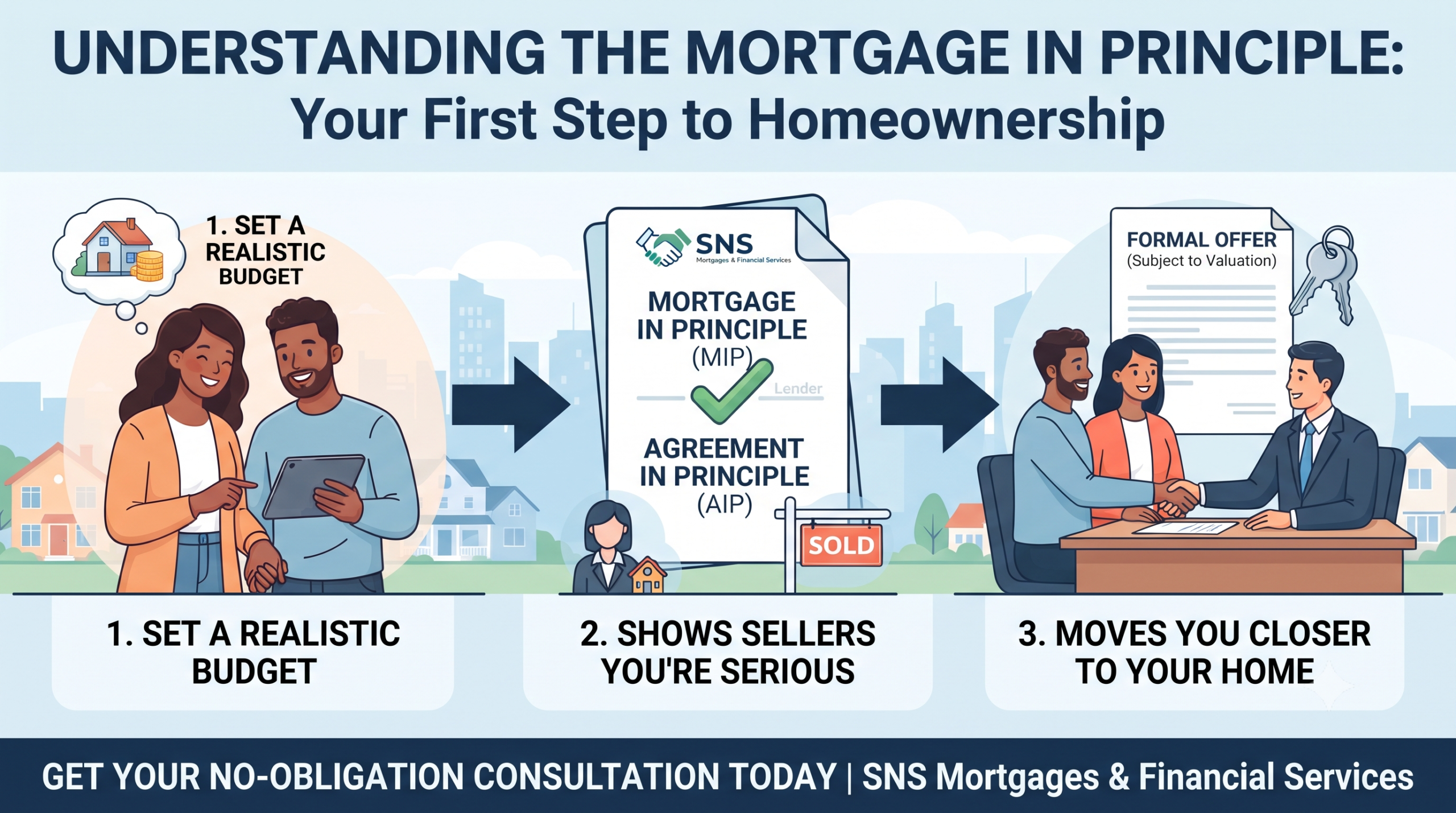
A Mortgage in Principle (sometimes called an Agreement in Principle) is an indication from a lender of how much they may be willing to lend you.
Benefits include:
- Showing estate agents you’re a serious buyer
- Understanding your budget
- Strengthening your offer on a property
- Giving confidence before house hunting
Although it’s not a formal mortgage offer, it’s often one of the first steps in the buying process.
The Mortgage Application Process
Buying your first home typically follows these steps:
Step 1
Review your finances.
Step 2
Save your deposit.
Step 3
Check your credit report.
Step 4
Speak with a mortgage adviser.
Step 5
Obtain a Mortgage in Principle.
Step 6
Search for your ideal property.
Step 7
Have your offer accepted.
Step 8
Submit your mortgage application.
Step 9
Property valuation takes place.
Step 10
Mortgage offer issued.
Step 11
Solicitors complete legal work.
Step 12
Exchange contracts.
Step 13
Completion day.
Step 14
Collect your keys and move into your new home.
Additional Costs to Consider
Many first-time buyers focus only on the deposit, but there are other costs involved.
These may include:
- Solicitor fees
- Property survey
- Mortgage arrangement fees
- Valuation fees
- Removal costs
- Buildings insurance
- Contents insurance
- Stamp Duty (where applicable)
- Utility setup costs
Budgeting for these expenses early helps avoid surprises later.
Government Support Schemes
Depending on your circumstances, you may benefit from government-backed schemes designed to help buyers get onto the property ladder.
Eligibility changes over time, so it’s always worth discussing the latest options with a qualified mortgage adviser.
At SNS Mortgages & Financial Services, we’ll explain which schemes may be suitable for your situation.
Common Mistakes First-Time Buyers Make
Avoid these common pitfalls:
- Taking out new credit before applying
- Missing bill payments
- Changing jobs during the application process
- Spending your deposit savings
- Forgetting about additional buying costs
- Applying with multiple lenders at once
- Choosing a mortgage based solely on the lowest interest rate
Professional advice can help you avoid these mistakes and improve your chances of approval.
Frequently Asked Questions
Can I get a mortgage with a 5% deposit?
Yes. Many lenders offer mortgages with a 5% deposit, although availability depends on your financial circumstances.
Can I get a mortgage if I’m self-employed?
Yes. You’ll usually need evidence of your income, such as tax calculations and accounts.
How long does the mortgage process take?
Most purchases complete within several weeks, although timescales vary depending on the property chain and legal process.
What credit score do I need?
There isn’t one universal score. Each lender uses its own criteria.
Should I use a mortgage broker?
A mortgage broker can compare products from multiple lenders, explain your options and guide you through the application process, potentially saving both time and money.
Can I overpay my mortgage?
Many lenders allow overpayments, although limits and conditions vary.
What happens after my mortgage is approved?
Your solicitor completes the legal work, contracts are exchanged, funds are transferred and you receive the keys on completion day.
Why Choose SNS Mortgages & Financial Services?
Buying your first home is a significant financial commitment, and having the right support can make all the difference.
At SNS Mortgages & Financial Services, we pride ourselves on providing clear, honest and personalised mortgage advice. We take the time to understand your circumstances, explain your options in plain English and help you find a mortgage that suits your goals—not just today, but for the future.
Whether you’re just starting to save for a deposit or you’re ready to submit your application, our experienced advisers are here to support you every step of the way.
Ready to Buy Your First Home?
If you’re thinking about purchasing your first property, don’t leave your mortgage to chance.
SNS Mortgages & Financial Services is here to help you understand your options, compare suitable mortgage products and guide you through the process with confidence.
Contact our friendly team today to arrange a no-obligation consultation and take the first step towards owning your first home.